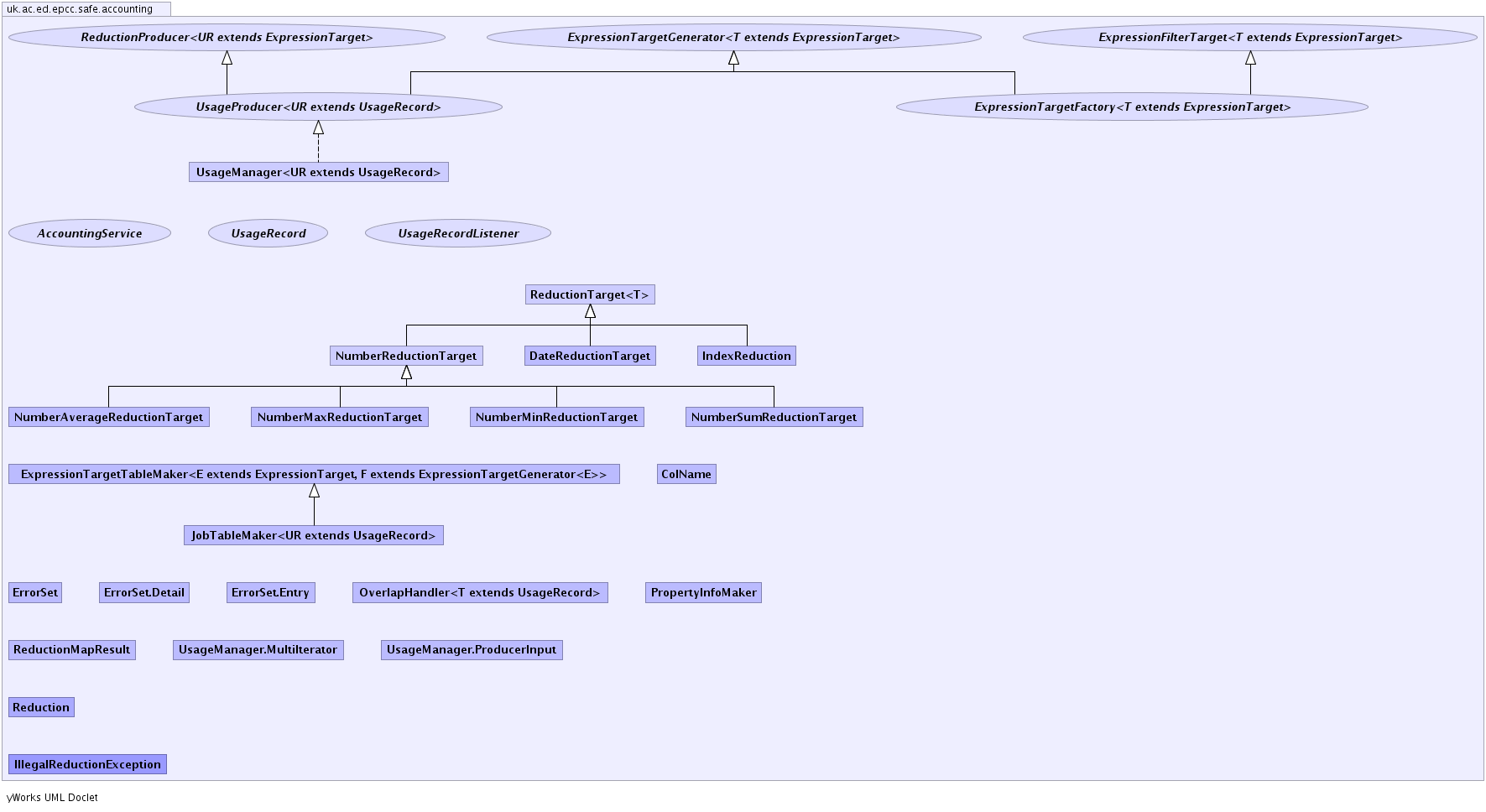
-
Interface Summary Interface Description AccountingService Service used to configure the AccountingExpressionFilterTarget<T extends ExpressionTarget> Interface for ExpressionTarget factories that can generate filters based on aPropExpressionExpressionTargetFactory<T extends ExpressionTarget> Interface that combinesExpressionFilterTargetandPropertyTargetFactoryand supports the generation ofSQLExpressions.ExpressionTargetGenerator<T extends ExpressionTarget> AnPropertyTargetGeneratorwhere the target is anExpressionTargetReductionProducer<UR extends ExpressionTarget> UsageProducer<UR extends UsageRecord> Interface implemented by classes that can provide Usage information to the reports.UsageRecord Interface implemented by all individual usage records.UsageRecordListener Interface for factory classes that need to see record insertion/deletion for example aggregate tables or budget managers. -
Class Summary Class Description ColName Simple parameter class for building tables from properties.DateReductionTarget AReductionTargetoperating on Dates.ErrorSet Collection of error messages.ErrorSet.Detail ErrorSet.Entry ExpressionTargetTableMaker<E extends ExpressionTarget,F extends ExpressionTargetGenerator<E>> Class to build a table of expressions values with one row per record.IndexReduction AReductionTargetthat generates an index value similar to an SQL GROUP BY clause.JobTableMaker<UR extends UsageRecord> Class to build a table of per-job information.NumberAverageReductionTarget AReductionTargetoperating on numbers that generate an average.NumberMaxReductionTarget AReductionTargetoperating on numbers.NumberMinReductionTarget AReductionTargetoperating on numbers.NumberReductionTarget NumberSumReductionTarget AReductionTargetoperating on numbers.OverlapHandler<T extends UsageRecord> Class that implements the logic of overlap calculations.PropertyInfoMaker Generates human readable summary of how properties are implemented for a particularUsageProducerReductionMapResult Result of a multiple reduction.ReductionTarget<T> A ReductionTarget represents aReductionof aPropExpressionover set of records.UsageManager<UR extends UsageRecord> A compositeUsageProducerthat combines results from several underlyingUsageProducers. -
Enum Summary Enum Description Reduction Reduction operators. -
Exception Summary Exception Description IllegalReductionException Exception thrown when an illegal reduction is requested
Package uk.ac.ed.epcc.safe.accounting Description
The aim of these classes is to support general accounting and report generation with a variety of deployment and accounting models.
The key item here is an accounting record. This contains a combination of different kinds of data:
- Raw factual information e.g. the accounting output of a batch system.
- Derived information due to local policy/infrastructure e.g. the charge applied to a job or the department the user belongs to.
This naturally leads us towards having implementation classes for different providers of factual information and augmenting them (by extension or composition) with the local policy. In practice some of the derived information needs to be stored and cannot just be generated on the fly from the factual data. Charging data needs to reflect the actual charge made in case charging parameters are changed. Also any derived quantities that will be used for record selection may need to be recorded with the record for performance reasons. In some cases raw data from different data sources needs to be combined. For example to add a log of which executables are running to the basic information in a batch accounting log.
There are different types of resource quantity we need to consider:
- An Annotation quantity that records something about the context of the record. for Example: the User or the Queue.
- An Point quantity measures the use of resources being consumed at a single point in time. For example: number of nodes in use, number of Kb occupied. As our data model only allows a single value for a property Point quantities that vary over time need to be represented by an indicative value such as the average.
- An Cumulative quantity that increases over time for example node-hours used by a job or Kb-days of disk usage, total page-faults. Charging is usually based on Cumulative quantities.
OverlapHandler.
The lowest common denominator of accounting record is something like:
- Period over which resource was used
- A set of properties corresponding to consumed resources (e.g. CPU time or charge)
- A set of properties giving information about the nature of the job (e.g. cpu-count or queue-name)
- A set of properties identifying responsibility for the job (e.g. user or project)
However this could represent many different things depending on the system. E.g.
- A single process
- A batch job
- The output of a days accounting summary
Many accounting operations require that some subset of the accounting records is selected. Usually by date-range and some record properties and a chart or table produced of one of the Extrinsic properties often divided into classes based on additional job properties. For example a table of CPU-time grouped by project.
We need to abstract out these different concepts to allow common code that can cope with the different quantities and properties supported by different accounting schemes. In addition we sometimes want to support aggregate reports over multiple types of accounting scheme. In which case we need a combining object that implements the same basic interface but only exposes those quantities and properties that are common to all the underlying schemes.
In order to support multiple accounting schemes at the same time we need a UsageManager
class to present a unified view of the tables from the different schemes.
Standard accounting only uses the functionality of UsageRecord.
Accounting data is queried via the UsageProducer interface.
UsageManager has to implement this interface.
The Factory classes for the various sub-classes of UsageRecord also need to present
a standard interface for the UsageManager to use. This is also UsageProducer
interface.
Because we wish to support aggregate operations over multiple tables we introduce an additional level of data
abstraction over that used by Repository/Record. Instead of identifying quantities by their database field name
we use PropertyTags. These are translated into objects from uk.ac.epcc.model.data.expr by the underlying classes. This allows properties
to be represented by different field names in different tables. Properties can also be used to reference complex expressions PropExpressions involving multiple
table fields.