-
- Type Parameters:
T- The type of object this parser generates from string values
- All Superinterfaces:
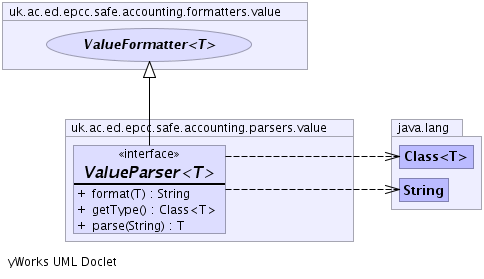
- ValueFormatter<T>
- All Known Implementing Classes:
- BooleanParser, DateParser, DateTimeParser, DecimalParser, DefaultFormatter, DoubleParser, FloatParser, IndexedReferenceValueParser, IntegerParser, LongParser, MemoryParser, NumberParser, PbsDateParser, ReferenceValueParser, SecondDurationParser, SimpleDurationParser, SlurmDurationParser, SlurmMemoryParser, StringParser, TimestampParser, TypeConverterValueParser, XMLDateTimeParser, XMLDurationParser
public interface ValueParser<T>
extends ValueFormatter<T>
An interface that denotes the implementing object is capable of converting between strings and objects of a certain type. Along with the constraints applied by this interface, all classes implementing this interface must define a no-argument constructor which properly constructs the parser. If no actual configuration is required, a constructor may be omitted entirely and the objects default constructor provided automatically by Java will be used instead.
-
-
Method Summary
Methods Modifier and Type Method and Description java.lang.Stringformat(T value)Format a value as a string.java.lang.Class<T>getType()Returns theClassof object this ValueParser can handle.Tparse(java.lang.String valueString)Parses the specified string and constructs the appropriate object out of it.
-
-
-
Method Detail
-
getType
java.lang.Class<T> getType()
Returns theClassof object this ValueParser can handle. Theparse(String)method must return objects that are assignable to this type. The#format(T)method can format any object assignable to this type. The returned class will be the exactClass(i.e. not a subclass) of thisValueParser's type- Specified by:
getTypein interfaceValueFormatter<T>- Returns:
- The Type of this
ValueParser
-
parse
T parse(java.lang.String valueString)
        throws ValueParseException
Parses the specified string and constructs the appropriate object out of it.- Throws:
ValueParseException- IfvalueStringis not of a format that allows this parser to convert it into an object of type T- Parameters:
valueString- The string to parse- Returns:
- The object representation of
valueString
-
format
java.lang.String format(T value)
Format a value as a string. The resulting string must be in a form that can be parsed by this ValueParser- Specified by:
formatin interfaceValueFormatter<T>- Parameters:
value-- Returns:
- String
-
-