- java.lang.Object
-
- uk.ac.ed.epcc.safe.accounting.update.AbstractPropertyContainerUpdater
-
- All Implemented Interfaces:
- PropertyContainerUpdater
- Direct Known Subclasses:
- AbstractPropertyContainerParser, BasePolicy, XMLPropertyDomParser
public abstract class AbstractPropertyContainerUpdater
extends java.lang.Object
implements PropertyContainerUpdater
Base class for implementingPropertyContainerUpdaterNote this contains the logic for building a default table specification by reflection and/or querying the config service.- Author:
- spb
- See Also:
AutoTable,OptionalTable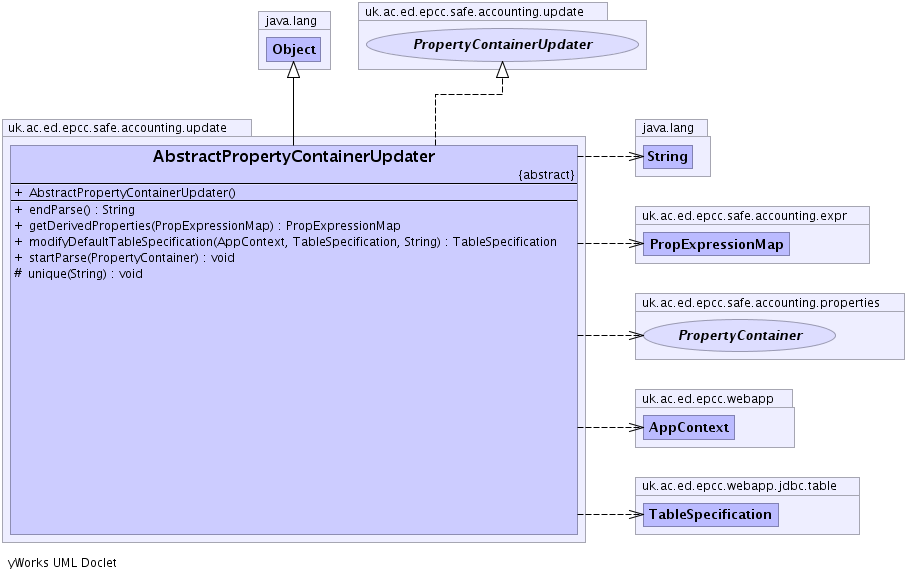
-
-
Constructor Summary
Constructors Constructor and Description AbstractPropertyContainerUpdater()
-
Method Summary
Methods Modifier and Type Method and Description java.lang.StringendParse()End a batch parse this de-allocates any temporary storage and and perform any final operations.PropExpressionMapgetDerivedProperties(PropExpressionMap previous)return a set of derived property definitions.uk.ac.ed.epcc.webapp.jdbc.table.TableSpecificationmodifyDefaultTableSpecification(uk.ac.ed.epcc.webapp.AppContext c, uk.ac.ed.epcc.webapp.jdbc.table.TableSpecification spec, java.lang.String table_name)Modify the default table specification if appropriate A null specification denotes that a table should not be auto-created.voidstartParse(PropertyContainer staticProps)Start a batch parse.protected voidunique(java.lang.String name)extension point called when creating the table specification when a field is labelled as part of the unique key.-
Methods inherited from class java.lang.Object
clone, equals, finalize, getClass, hashCode, notify, notifyAll, toString, wait, wait, wait
-
Methods inherited from interface uk.ac.ed.epcc.safe.accounting.update.PropertyContainerUpdater
initFinder
-
-
-
-
Method Detail
-
modifyDefaultTableSpecification
public uk.ac.ed.epcc.webapp.jdbc.table.TableSpecification modifyDefaultTableSpecification(uk.ac.ed.epcc.webapp.AppContext c,
                                                                                 uk.ac.ed.epcc.webapp.jdbc.table.TableSpecification spec,
                                                                                 java.lang.String table_name)
Description copied from interface:PropertyContainerUpdaterModify the default table specification if appropriate A null specification denotes that a table should not be auto-created. Most work is usually done by the parser (modifying a blank or minimal specification) A policy may alo make changes if it is pre-configured before the table is created. Normally policies are added to an existing table where this method is not relevant.- Specified by:
modifyDefaultTableSpecificationin interfacePropertyContainerUpdater- Parameters:
c- AppContextspec- TableSpecification or null- Returns:
- modified TableSpecification
-
unique
protected void unique(java.lang.String name)
extension point called when creating the table specification when a field is labelled as part of the unique key.- Parameters:
name- Field name
-
endParse
public java.lang.String endParse()
Description copied from interface:PropertyContainerUpdaterEnd a batch parse this de-allocates any temporary storage and and perform any final operations.- Specified by:
endParsein interfacePropertyContainerUpdater- Returns:
- Error string if any
-
getDerivedProperties
public PropExpressionMap getDerivedProperties(PropExpressionMap previous)
Description copied from interface:PropertyContainerUpdaterreturn a set of derived property definitions. Each derived property is defined in terms of a simple expression over other properties (that may themselves be derived properties).Definitions are allowed for properties that are also generated directly in the parse phase. In this case the parse value should always be used by preference and the derived definition only provides a fall-back implementation if the parse value is unavailable. For example if not persisted in the database layer. This allows one parser/policy to specify a default implementation as a derived property definition which is then overridden by having the same property generated in a parse method of a different policy/parser
- Specified by:
getDerivedPropertiesin interfacePropertyContainerUpdater- Parameters:
previous- Previous definitions- Returns:
- Map modified map
-
startParse
public void startParse(PropertyContainer staticProps)
                throws java.lang.Exception
Description copied from interface:PropertyContainerUpdaterStart a batch parse. This allocates any temporary state appropriate to the policy. Some properties may be set globally for all records in the parse rather than provided record by record. The startParse method is passed all known properties of this type as they may be useful in setting up the parse. There is no requirement to process these in any way.- Specified by:
startParsein interfacePropertyContainerUpdater- Throws:
java.lang.Exception- Parameters:
staticProps- properties constant for this accounting run.
-
-