- java.lang.Object
-
- uk.ac.ed.epcc.safe.accounting.update.AbstractPropertyContainerUpdater
-
- uk.ac.ed.epcc.safe.accounting.update.AbstractPropertyContainerParser
-
- uk.ac.ed.epcc.safe.accounting.update.BaseParser
-
- uk.ac.ed.epcc.safe.accounting.update.ReadOnlyParser
-
- All Implemented Interfaces:
- PropertyContainerParser, PropertyContainerUpdater
public class ReadOnlyParser
extends BaseParser
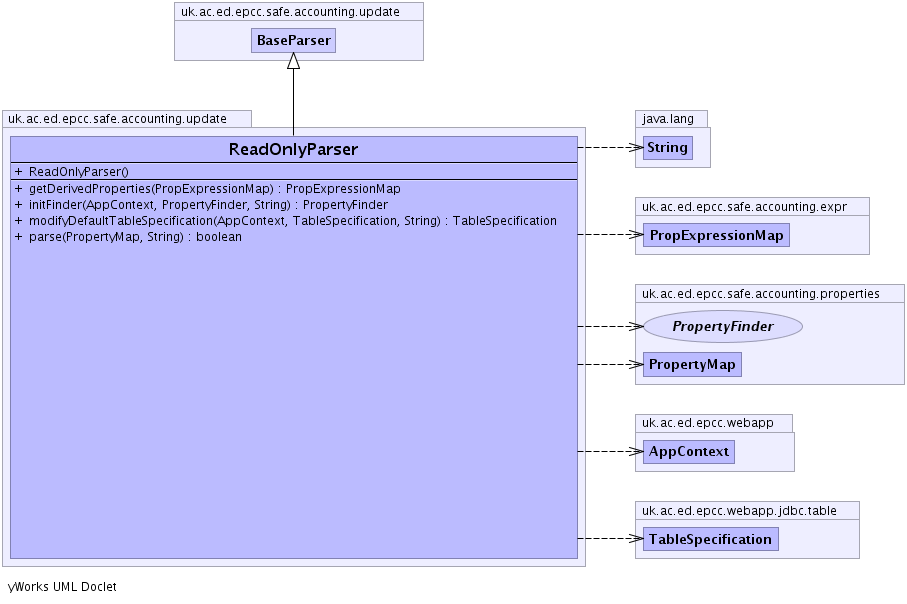
A Placeholder parser for read-only tables
-
-
Field Summary
-
Fields inherited from class uk.ac.ed.epcc.safe.accounting.update.AbstractPropertyContainerParser
DUPLICATE_KEY
-
-
Constructor Summary
Constructors Constructor and Description ReadOnlyParser()
-
Method Summary
Methods Modifier and Type Method and Description PropExpressionMapgetDerivedProperties(PropExpressionMap previous)return a set of derived property definitions.PropertyFinderinitFinder(uk.ac.ed.epcc.webapp.AppContext conn, PropertyFinder prev, java.lang.String table)Generate a PropertyFinder that will find any PropertyTag generated by this class.uk.ac.ed.epcc.webapp.jdbc.table.TableSpecificationmodifyDefaultTableSpecification(uk.ac.ed.epcc.webapp.AppContext c, uk.ac.ed.epcc.webapp.jdbc.table.TableSpecification spec, java.lang.String table_name)Modify the default table specification if appropriate A null specification denotes that a table should not be auto-created.booleanparse(PropertyMap map, java.lang.String record)Parse a String representation of the UsageRecord.-
Methods inherited from class uk.ac.ed.epcc.safe.accounting.update.BaseParser
readDouble, readInteger, readLong, readTime
-
Methods inherited from class uk.ac.ed.epcc.safe.accounting.update.AbstractPropertyContainerParser
getDefaultUniqueProperties, splitRecords, unique
-
Methods inherited from class uk.ac.ed.epcc.safe.accounting.update.AbstractPropertyContainerUpdater
endParse, startParse
-
Methods inherited from class java.lang.Object
clone, equals, finalize, getClass, hashCode, notify, notifyAll, toString, wait, wait, wait
-
Methods inherited from interface uk.ac.ed.epcc.safe.accounting.update.PropertyContainerUpdater
endParse, startParse
-
-
-
-
Method Detail
-
modifyDefaultTableSpecification
public uk.ac.ed.epcc.webapp.jdbc.table.TableSpecification modifyDefaultTableSpecification(uk.ac.ed.epcc.webapp.AppContext c,
                                                                                 uk.ac.ed.epcc.webapp.jdbc.table.TableSpecification spec,
                                                                                 java.lang.String table_name)
Description copied from interface:PropertyContainerUpdaterModify the default table specification if appropriate A null specification denotes that a table should not be auto-created. Most work is usually done by the parser (modifying a blank or minimal specification) A policy may alo make changes if it is pre-configured before the table is created. Normally policies are added to an existing table where this method is not relevant.- Specified by:
modifyDefaultTableSpecificationin interfacePropertyContainerUpdater- Overrides:
modifyDefaultTableSpecificationin classAbstractPropertyContainerParser- Parameters:
c- AppContextspec- TableSpecification or null- Returns:
- modified TableSpecification
-
parse
public boolean parse(PropertyMap map,
            java.lang.String record)
              throws AccountingParseException
Description copied from interface:PropertyContainerParserParse a String representation of the UsageRecord. If the parse needs to be aborted throw and AccountingParseException. If the parse cannot succeed but no error needs to be reported (e.g. an empty or comment line) this method can return false- Throws:
AccountingParseException- Parameters:
map- PropertyMap to add quantities- Returns:
- true if parse ok
-
initFinder
public PropertyFinder initFinder(uk.ac.ed.epcc.webapp.AppContext conn,
                        PropertyFinder prev,
                        java.lang.String table)
Description copied from interface:PropertyContainerUpdaterGenerate a PropertyFinder that will find any PropertyTag generated by this class. This call should be treated as a secondary constructor and should be called before any other method from this interface.All properties defined at run-time should have their PropertyTag objects constructed by the time the first call to this method returns. As some parsers properties will generate different things depending on the other properties already in scope this method is passed a PropertyFinder for any properties that may already be in scope. This will include any default parameters specified when the data was uploaded and any properties generated from the database meta-data. Though it is perfectly legal to return a PropertyFinder that returns a superset of the generated properties the only requirement is that the returned finder can find any property that this classes parse method may actually generate values for. So Normally the contents of the super-finder are not included in the result unless these values are actually generated by the parse. If values are generated then a MultiFinder can be populated with the PropertyRegistrys from the generated properties
- Specified by:
initFinderin interfacePropertyContainerUpdater- Overrides:
initFinderin classBaseParserprev- PropertyFinder for the higher levels in the call chain.table- String name of the destination table in case per-table customisation is needed- Returns:
- PropertyFinder or null
-
getDerivedProperties
public PropExpressionMap getDerivedProperties(PropExpressionMap previous)
Description copied from interface:PropertyContainerUpdaterreturn a set of derived property definitions. Each derived property is defined in terms of a simple expression over other properties (that may themselves be derived properties).Definitions are allowed for properties that are also generated directly in the parse phase. In this case the parse value should always be used by preference and the derived definition only provides a fall-back implementation if the parse value is unavailable. For example if not persisted in the database layer. This allows one parser/policy to specify a default implementation as a derived property definition which is then overridden by having the same property generated in a parse method of a different policy/parser
- Specified by:
getDerivedPropertiesin interfacePropertyContainerUpdater- Overrides:
getDerivedPropertiesin classBaseParser- Parameters:
previous- Previous definitions- Returns:
- Map modified map
-
-